
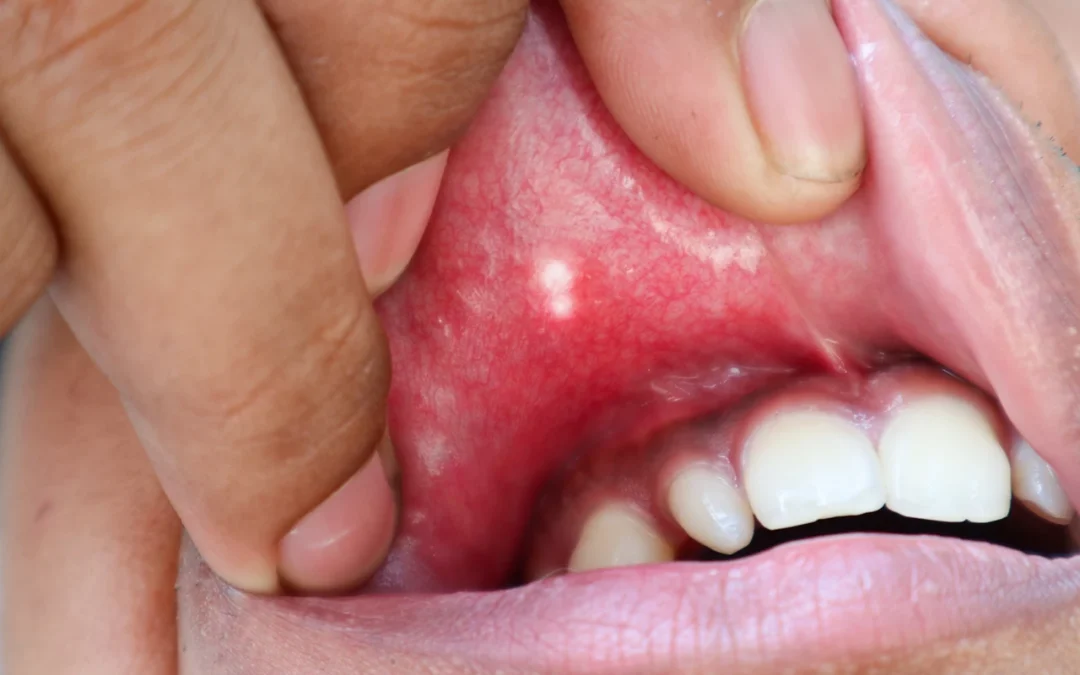
Few things in the mouth cause as much pain relative to their size as a canker sore. A lesion smaller than a pencil eraser can make eating, drinking, and talking miserable for a week or more — and because they tend to show up without warning, most people have no idea what triggered the one they’re currently dealing with.
Canker sores are among the most common oral conditions patients ask about, and also among the most misunderstood. They are not contagious, not caused by a virus, and not related to cold sores in any meaningful way, despite how often the two get confused.
What a Canker Sore Looks Like
Canker sores are shallow, round or oval ulcers that form on the soft tissue inside the mouth. They typically have a white, yellow, or grayish center with a distinct red border around the edge.
That pale center is the part people ask about most. It isn’t pus and it isn’t infection — it’s a layer of fibrin and dead tissue covering the exposed ulcer bed underneath, the same way a scab forms over a cut on your skin. The red ring around it is inflamed tissue reacting to the damage.
Most canker sores measure under a quarter inch across. Larger ulcers, sometimes exceeding half an inch, are less common, tend to be deeper, and can take several weeks to resolve rather than several days.
Canker sores generally don’t bleed on their own. If one is bleeding, something has usually irritated it — a toothbrush bristle, a sharp piece of food, a dental appliance rubbing against it. Persistent bleeding from a mouth ulcer isn’t typical and should be looked at.
Canker Sores vs. Cold Sores
This is the single biggest source of confusion around canker sores, and the distinction matters because the two conditions have almost nothing in common.
Canker sores form inside the mouth, on soft tissue that moves — the inner cheeks, the underside of the tongue, the inside of the lips, the base of the gums. Cold sores form outside, on the lip border and the skin around it.
Canker sores are not caused by a virus. Cold sores are caused by herpes simplex, which is why the “are canker sores herpes” question comes up so often and why the answer matters to people who are worried.
Canker sores cannot be transmitted to another person. There is no mechanism for spreading them — not by kissing, not by sharing a drink, not by utensils. Cold sores are contagious, particularly during an active outbreak.
Canker sores also don’t spread within your own mouth. Someone who develops two or three at once didn’t have one sore multiply; they had multiple ulcers triggered by the same underlying cause at the same time.
Where Canker Sores Form
Canker sores need soft, movable tissue. They don’t form on the hard, tightly attached tissue of the gums directly around the teeth, and they don’t form on the outside of the lips.
The most common locations:
- Inner cheeks — especially where the cheek meets the teeth, and especially after an accidental bite
- Tongue — the underside and the sides are typical; the top surface less so
- Inside of the lips — the soft inner lining, not the outer lip border
- Base of the gums — where gum tissue transitions to the softer tissue of the cheek or lip
- Soft palate — the soft rear portion of the roof of the mouth
The roof of the mouth is a partial exception. The hard palate toward the front rarely develops canker sores, but the soft palate further back can.
Ulcers appearing in the throat or on the tonsils are a different matter. Those areas are outside the usual territory for canker sores, and what looks like one back there is more often tonsil stones, strep, tonsillitis, or another infection entirely. A sore throat with visible lesions on the tonsils is a reason to be seen rather than to self-treat as a canker sore.
What Causes Canker Sores
There’s no single cause, which is part of why they’re so frustrating. Canker sores appear to result from a localized immune response to some form of tissue insult, and what constitutes an insult varies considerably from person to person.
Physical trauma is the most identifiable trigger. Biting the inside of your cheek, catching soft tissue with a toothbrush, irritation from braces or a denture edge, or tissue disturbed during dental work can all precede a sore by a day or two.
Stress shows up constantly in patient histories. Many people can map their outbreaks directly onto exam weeks, work deadlines, or periods of poor sleep. The mechanism likely involves immune function rather than stress acting on tissue directly.
Certain foods provoke sores in susceptible people — acidic fruits, tomatoes, vinegar, chocolate, coffee, and spicy dishes are the usual suspects. Sodium lauryl sulfate, a foaming agent in many toothpastes, is a well-documented trigger for some patients, and switching to an SLS-free toothpaste eliminates the problem for a meaningful number of frequent sufferers.
Nutritional gaps matter too, particularly low vitamin B12, iron, folate, and zinc. Hormonal fluctuation is another recognized factor, which is why some women see a consistent monthly pattern.
Genetics play a real role. Canker sores run in families, and patients with a parent or sibling who gets them frequently are considerably more likely to get them themselves.
How to Get Rid of Canker Sores
Most canker sores heal on their own within seven to fourteen days without any treatment at all. Treatment is about reducing pain and shortening the timeline, not about curing something that would otherwise persist.
Over-the-counter topical gels containing benzocaine numb the surface temporarily and make eating tolerable. Protective pastes form a barrier over the ulcer, which helps considerably since much of the ongoing pain comes from the exposed nerve endings being hit by food, drink, and tongue movement.
A warm saltwater rinse is the most reliable home remedy — a half teaspoon of salt in a cup of warm water, swished for thirty seconds and spit out, a few times a day. It won’t heal the sore faster in any dramatic sense, but it keeps the area clean and reduces inflammation. Baking soda rinses work similarly.
Diluted hydrogen peroxide is sometimes recommended and can be used cautiously as an antiseptic rinse, but it should be diluted well and used sparingly. Applying it at full strength to an open ulcer irritates the tissue and can make things worse rather than better.
Alcohol-based mouthwashes are the wrong choice during an outbreak. They sting badly and dry out tissue that’s already compromised. An alcohol-free antimicrobial rinse is a better option if you want one.
There are also steps that speed up healing and take the edge off the pain quickly when you need relief in the first day rather than over the course of a week.
A few things to avoid: don’t try to pop a canker sore. It isn’t a blister and there’s nothing inside it — it’s already an open ulcer, and picking at it delays healing and invites bacterial infection. Skip acidic and spicy foods until it resolves, and be gentle with the toothbrush around the affected area.
Recurring and Chronic Canker Sores
Getting one occasionally is normal. Getting them constantly is a signal that something identifiable may be driving them.
Patients who develop sores every few weeks, or who never fully clear one before the next appears, are dealing with recurrent aphthous stomatitis — the clinical term for chronic canker sores. A few culprits account for most persistent patterns, and working through them methodically usually turns something up:
- An SLS-containing toothpaste that’s irritating tissue with every brushing
- A nutritional deficiency, most often B12, iron, or folate
- A sharp tooth edge, rough filling, or ill-fitting appliance causing repeated trauma to the same spot
- An underlying condition such as celiac disease, inflammatory bowel disease, or Behçet’s disease
Sores that recur in the exact same location each time point strongly toward mechanical irritation, and that’s usually the easiest version to solve — a dentist can smooth the offending edge or adjust the appliance and the pattern stops.
When a Canker Sore Should Be Looked At
Most canker sores don’t require professional attention. These characteristics do:
- A sore that hasn’t healed after two to three weeks
- Unusually large or deep ulcers
- Sores that keep appearing before the previous one has healed
- Fever, swollen lymph nodes, or difficulty swallowing alongside the sore
- Pain severe enough that you can’t eat or drink adequately
- Bleeding that doesn’t stop, or a sore that appears infected
Any mouth ulcer lasting beyond three weeks should be evaluated regardless of how it feels. The vast majority turn out to be ordinary canker sores that are simply healing slowly, but persistent oral lesions are also how oral cancer presents, and ruling that out is a five-minute conversation.
Schedule Your Visit at Tulsa Dental Center
If canker sores are a constant presence rather than an occasional nuisance, there’s usually a reason — and it’s often something correctable. The team at Tulsa Dental Center can look for the trigger, address any mechanical irritation, and make sure nothing more serious is behind the pattern.
Call (918) 446-6100, email appointments@tulsadentalcenter.com, or contact us online. We’re located at 4824 S Union Ave, Tulsa, OK 74107.
Frequently Asked Questions About Canker Sores
Are canker sores contagious?
No. Canker sores are not caused by a virus or bacteria and cannot be passed to another person through kissing, sharing drinks, or sharing utensils. This is the clearest difference between canker sores and cold sores, which are caused by the herpes simplex virus and are contagious during an outbreak.
How long do canker sores last?
Most heal within seven to fourteen days. Smaller sores often resolve closer to a week, while larger or deeper ulcers can take several weeks. Any sore still present after three weeks should be evaluated by a dentist.
Why do canker sores hurt so much for their size?
Because a canker sore is an open ulcer with exposed nerve endings, sitting in an environment that never stops moving. Every swallow, every word, and every bite of food makes direct contact with unprotected tissue, which is why a lesion a few millimeters across can dominate your entire day.
Can you pop a canker sore?
No, and attempting to will make it worse. A canker sore isn’t a blister and contains no fluid — it’s already an open wound. Picking at it damages healing tissue and increases the risk of a secondary bacterial infection.
Do canker sores bleed?
Not on their own. Bleeding usually means the sore has been irritated by a toothbrush, sharp food, or a dental appliance rubbing against it. A mouth ulcer that bleeds persistently without an obvious cause should be looked at.
Can stress cause canker sores?
Stress is one of the most frequently reported triggers. It doesn’t damage tissue directly, but it affects immune function, and many patients can trace their outbreaks to periods of high stress, poor sleep, or illness.
Are canker sores genetic?
There is a clear familial pattern. People with a parent or sibling who gets canker sores frequently are significantly more likely to experience them, though the specific triggers still vary from person to person within the same family.
Recent Comments