
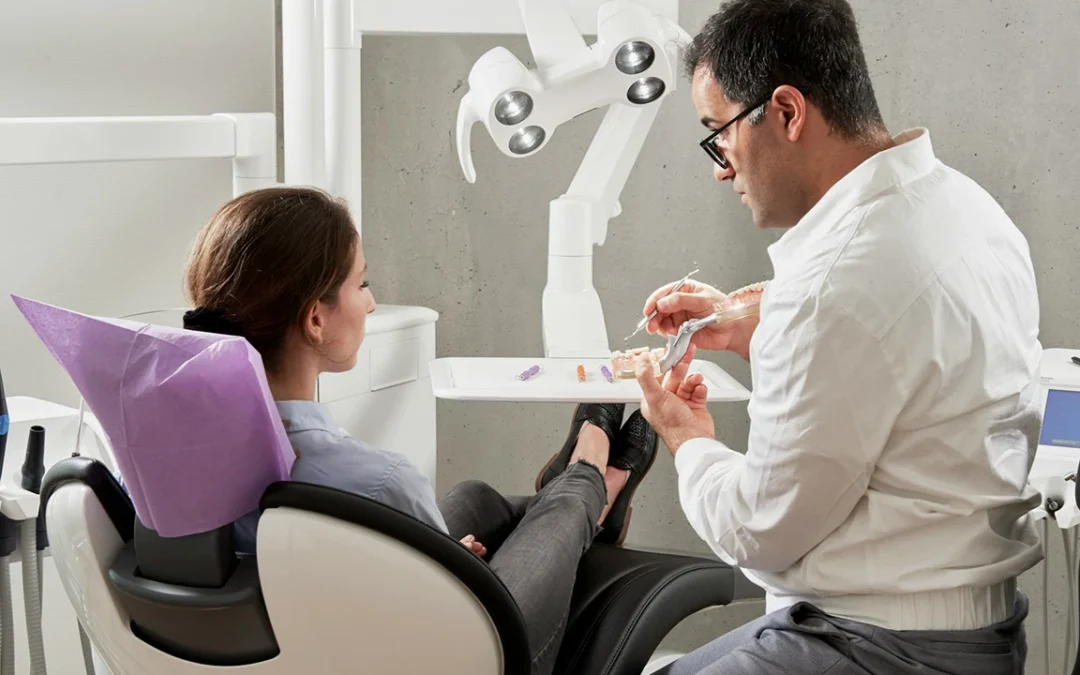
There’s a common assumption that a diligent home routine makes professional cleanings optional — that brushing twice a day and flossing nightly covers everything, and the six-month appointment is more of a formality than a necessity.
It isn’t. Dental cleanings exist to handle a specific problem that no toothbrush can solve, and understanding that problem is the fastest way to understand why the appointment matters.
Professional cleanings are the backbone of preventative dentistry, and they’re the single most reliable predictor of whether a patient spends their forties dealing with fillings and gum treatment or coasting through routine checkups.
What a Cleaning Removes That Brushing Can’t
Plaque is soft. It forms constantly, it’s colorless, and brushing and flossing remove it effectively when you get to it in time.
Tartar is a different substance entirely. When plaque sits undisturbed for roughly 48 to 72 hours, minerals in your saliva calcify it into a hardened deposit that bonds directly to the tooth surface. At that point it stops being something you can brush away. It has to be scraped off with instruments designed for the job.
This is the entire reason professional cleanings exist. Not because patients brush badly — even excellent brushers miss spots consistently, usually the same spots every time. The back molars, the inside surfaces of the lower front teeth, and the areas just below the gumline are where tartar accumulates in nearly everyone.
Tartar below the gumline is the version that causes real damage. It creates a rough surface that attracts more bacteria, holds them against gum tissue, and drives the inflammation that becomes gum disease. Removing it is the difference between gingivitis that resolves and periodontitis that permanently destroys bone.
Types of Dental Cleanings
Not every cleaning is the same procedure, and the type you need depends on the current state of your gums rather than on preference or budget.
- Routine prophylaxis — the standard cleaning for patients with healthy gums and no bone loss. It addresses tartar above and slightly below the gumline and takes about 30 to 45 minutes.
- Scaling and root planing — often called a deep cleaning. It reaches tartar well below the gumline and smooths the root surfaces so gum tissue can reattach. Usually performed with local anesthetic and often split across two visits.
- Periodontal maintenance — the ongoing cleaning schedule for patients who’ve had scaling and root planing. Typically every three to four months rather than every six, because periodontal pockets recolonize with bacteria faster than healthy gum tissue does.
- Full mouth debridement — used when tartar buildup is heavy enough that the dentist can’t properly examine the teeth underneath. It clears the way for an accurate diagnosis, with the real cleaning following at a second appointment.
Patients sometimes push back on being recommended a deep cleaning, assuming it’s an upsell over the routine version. It isn’t a preference. Scaling and root planing is prescribed based on measurable findings — pocket depths, bleeding points, and bone levels visible on X-rays. A routine cleaning performed on gums that need scaling leaves the disease process running underneath.
What to Expect During a Dental Cleaning
Most patients who avoid cleanings out of anxiety are imagining something worse than what happens.
The appointment starts with an examination. The hygienist checks your gums, measures pocket depths around each tooth, and looks for signs of decay, and X-rays may be taken depending on when you last had them.
Scaling comes next. This is the part people picture — instruments removing tartar from tooth surfaces and just under the gumline. Ultrasonic scalers do most of the heavy work with vibration and a water spray, and hand instruments handle the detail. You’ll hear it more than you feel it.
Polishing follows, using a gritty paste and a rotating rubber cup to smooth the tooth surfaces and lift surface stains. Flossing clears whatever the scaling and polishing dislodged, and a fluoride treatment often finishes the appointment.
Sensitivity afterward is normal and usually passes within a day or two, particularly for patients who haven’t had a cleaning in a while. Gums that bleed during the appointment are showing inflammation, not injury from the cleaning itself — healthy gums don’t bleed when scaled.
How Often You Need Dental Cleanings
Twice a year is the familiar default, and for patients with healthy gums and a low cavity rate, it holds up well.
It isn’t universal, though. Patients with a history of gum disease typically need cleanings every three to four months, because periodontal pockets accumulate bacteria faster than a six-month interval accommodates. Smokers, patients with diabetes, pregnant patients, and anyone with a history of frequent decay often benefit from more frequent visits as well. Some patients with excellent oral health and no risk factors do fine on a longer interval.
The right frequency is a clinical judgment based on what’s happening in your mouth, not a fixed rule applied to everyone. Cleanings and exams often run on the same schedule, but they don’t have to — how often you should see the dentist for a checkup depends on the same risk factors and can land on a different interval than your cleaning schedule.
What Dental Cleanings Cost
Cost varies by the type of cleaning and by whether you’re insured. A routine prophylaxis is among the least expensive procedures in dentistry, and most dental insurance plans cover two per year at or near 100% specifically because insurers understand the math — cleanings are dramatically cheaper than the fillings, root canals, and periodontal treatment they prevent.
Scaling and root planing costs more, since it’s quoted per quadrant and typically involves anesthetic and multiple appointments. Insurance usually covers it at a lower percentage than routine cleanings, often 50 to 80%.
For uninsured patients, a cleaning remains the least expensive point of entry into dental care. What a teeth cleaning costs without insurance varies by region and by practice, but skipping cleanings to save money reliably produces larger bills later.
Why Cleanings Matter Beyond Your Teeth
The case for regular cleanings isn’t only about avoiding cavities.
Gum disease creates chronic inflammation and a persistent bacterial load that enters the bloodstream through compromised tissue. Research has connected periodontal disease to cardiovascular disease, and the relationship with diabetes runs in both directions — each condition makes the other harder to manage, and treating gum disease measurably improves glucose control in diabetic patients.
There’s also the diagnostic value, which patients tend to overlook. A cleaning appointment includes an oral cancer screening, an examination of every tooth surface, and a periodontal assessment. Small cavities get caught while they still need a filling instead of a crown. Early gum disease gets caught while it’s still reversible.
That’s the real return on the appointment: not the polish, but everything the visit surfaces that you’d otherwise find out about a year or two later, when the fix is bigger.
Schedule Your Visit at Tulsa Dental Center
Whether you’re on a regular schedule or it’s been longer than you’d like to admit, the team at Tulsa Dental Center will meet you where you are — no lectures, no judgment.
Call (918) 446-6100, email appointments@tulsadentalcenter.com, or contact us online. We’re located at 4824 S Union Ave, Tulsa, OK 74107.
Frequently Asked Questions About Dental Cleanings
How often should you get dental cleanings?
Twice a year suits most patients with healthy gums. Patients with a history of gum disease usually need cleanings every three to four months, and smokers, diabetic patients, and those prone to decay often benefit from a shorter interval as well. Your dentist sets the schedule based on pocket depths, bleeding, and your overall risk profile.
Do dental cleanings hurt?
For most patients, no. You’ll feel pressure and vibration and hear the instruments, but discomfort is usually minimal. Patients with inflamed gums or heavy tartar buildup tend to feel more, which is one reason longer gaps between cleanings make each one less pleasant. Deep cleanings are performed with local anesthetic.
Can a dental cleaning damage your teeth?
No. Scaling removes tartar from the enamel surface without harming the tooth underneath. The sensitivity some patients notice afterward comes from newly exposed tooth surfaces that were previously covered by tartar, and it typically settles within a day or two.
Why do my gums bleed during a cleaning?
Bleeding indicates inflammation from bacteria along and below the gumline, not injury caused by the cleaning. Healthy gum tissue doesn’t bleed when it’s scaled. Bleeding during an appointment is useful diagnostic information, and it generally decreases substantially once the tartar driving it is removed and home care improves.
Do I still need cleanings if I brush and floss every day?
Yes. Brushing and flossing remove plaque, but once plaque hardens into tartar — which takes only a couple of days in the spots people consistently miss — no amount of home care will remove it. Cleanings handle what has already calcified, particularly below the gumline where it does the most damage.
What happens if you never get your teeth cleaned?
Tartar accumulates unchecked, gum inflammation progresses from gingivitis to periodontitis, and the bone supporting your teeth begins to erode. That bone loss is permanent. Untreated periodontal disease is the leading cause of tooth loss in adults, and it develops without pain until it’s advanced.
Recent Comments